6LearnSwim Pathway, stage 6: Stroke development
How to swim backstroke
Backstroke keeps your face out of the water, which many beginners find reassuring. It builds directly on floating on your back and the same flutter kick used in freestyle.
Short answer
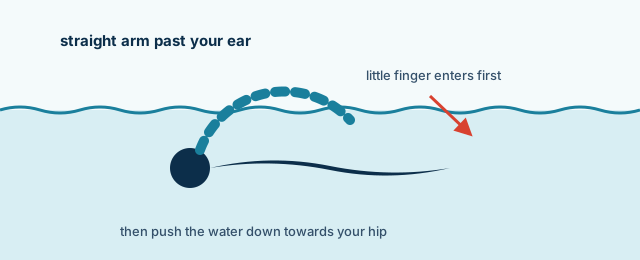
Float on your back with ears in the water and eyes looking up, kick steadily from the hips, and rotate your arms one at a time: straight arm out of the water past your ear, little finger enters first, then pull down towards your hip.
Start with a back float
If you can't yet float on your back calmly and stand up from it, start there. Backstroke is basically a moving back float.
Head and body position
- Ears under the water, eyes looking straight up.
- Chin neither tucked nor pushed back.
- Hips up. If you "sit" in the water, your legs will drag.
- Keep your head still. It's the anchor for the whole stroke.
The kick
The same flutter kick as freestyle, from the hips, with knees staying under the surface. If your knees break the surface, you're bending them too much.
The arms
- Lift one straight arm out of the water, thumb first.
- Swing it up past your ear.
- Enter the water little finger first, roughly in line with your shoulder.
- Bend the elbow slightly and push the water down towards your hip.
- As one arm pulls, the other recovers. Your body rolls gently side to side.
Breathing
Your face is out, but don't hold your breath. Breathing in on one arm and out on the other keeps you relaxed. Water splashing over your face is normal; breathing out through your nose helps.
Drills
- Back kick with arms by your sides.
- Back kick holding a kickboard to your chest.
- Single-arm backstroke, other arm by your side.
- Full stroke over short distances.
Check the wall markers
You cannot see the wall while swimming backstroke. Some pools use overhead flags or other markers, but their setup can vary. Ask the lifeguard or instructor how the lane is marked, do not rely only on stroke counting, and practise short distances in a designated shallow area with direct supervision.
Technique source
Swim England’s backstroke guidance describes a long back position, alternating kick, continuous arm action and regular breathing. The steps above break those elements into supervised beginner practice.
Common questions
Why do I sink when I swim backstroke?
Possible causes include dropped hips, lifting the head to look at the feet, a large knee-led kick, tension or limited forward movement. Recheck head and hip position, use a small continuous kick and practise where you can stand.
Is backstroke good for beginners?
It can suit some beginners because the mouth and nose stay above the surface during normal swimming, but others find the face-up position or limited view uncomfortable. Stroke order should reflect confidence, body control and goals.
How do I stop water going up my nose?
A gentle nasal exhalation when water approaches the face may help. Keep the head steady and avoid tipping it back; a properly fitted nose clip is another option where pool rules allow it.
More on SwimmingCourse.sg: 8 types of swimming strokes and How to swim freestyle and backstroke faster.
Written by Alvin, SSI Swimming Instructor Trainer, published with Swim2u Swim School. Last reviewed 26 October 2026. How we check our content.