1LearnSwim Pathway, stage 1: Water confidence
Learn to Swim as an Adult in Singapore
Adults may start swimming for the first time or return after years away. A suitable starting plan should reflect water confidence, mobility, health, prior experience and personal goals.
Short answer
Adults can learn swimming skills, but the outcome and timeline vary. The appropriate starting point depends on water confidence, mobility, health, prior experience and goals. Begin in shallow, supervised water with controlled breathing and recovery to standing, and progress at a manageable pace.
What's different about learning as an adult
You think more, and that's both good and bad
Adults may be able to connect detailed instructions to a clear goal and practise deliberately. Some also become tense while concentrating, which can make breathing and body position harder to coordinate. The useful response is to simplify the skill, slow down and regain comfortable breathing.
Fear has had longer to build
If a past experience makes the water feel difficult, say so before the lesson and use a gradual approach without forced submersion. The pace should respond to your comfort and recovery between attempts. See overcoming fear of water.
Bodies float differently
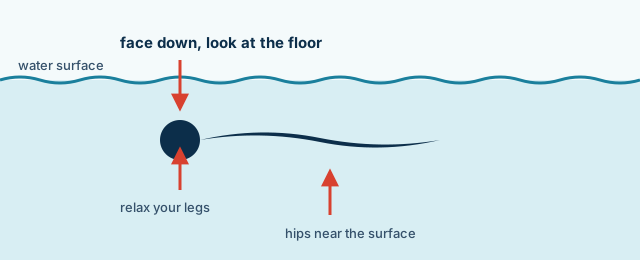
Adults with lean, muscular legs often feel their legs sink. It doesn't mean you can't swim. It means body position and a steady kick matter more for you. Why some people sink, and what to do.
Worried about embarrassment?
Self-consciousness can make it harder to relax and focus. A few options may help:
- Ask the venue which periods are usually less busy before choosing a lesson time.
- Start with private lessons, or learn at a condo pool.
- Focus on one agreed skill at a time instead of comparing your progress with nearby swimmers.
- If you'd feel more comfortable with a female coach, ask for one.
A realistic adult learning path
- Comfort: walking, submerging your shoulders, face in with bubbles.
- Recovery: standing up from front and back floats. This is your safety skill.
- Floating and gliding: learning the flat body position.
- Kicking: small kicks from the hips, with a board at first.
- First stroke: freestyle or breaststroke over short distances, standing up to rest.
- Continuous swimming: linking strokes with rhythmic breathing.
- Deeper water: only once you can swim and recover confidently in the shallow end.
Private or group lessons for adults?
Private lessons provide individual pacing and feedback, which may suit nervous learners or people with specific goals. Small groups provide peer interaction and may cost less per learner. The suitable format depends on confidence, attention, budget and availability. Compare lesson formats.
Lady and adult formats at Swim2u
Swim2u lists adult lessons and ladies' lessons with female coaches, each as a 4-lesson package of 45-minute sessions, privately or in a group of 2 or more. If you would feel more at ease with a woman teaching you, see Swim2u's ladies' swimming lessons with female instructors; the pool is still shared with other swimmers. Rates are in the cost guide. Before you book, ask which coach and venue apply, what happens if you miss a lesson (see the policy summary), and use the progress checklist to set a first goal with your coach.
Realistic expectations
- Progress is rarely a straight line. You'll have sessions where things click and sessions where they don't.
- Comfort and stroke coordination develop at different rates for different learners.
- Brief, supervised practice between lessons can reinforce the previous skill.
- Swimming a length without stopping is a different milestone from being comfortable in deep water; neither should be treated as automatic.
More on timing: how long learning takes and how many lessons adults usually need.
Practise safely
Practise in water shallow enough to stand in, at a pool with a lifeguard or a capable adult watching you. Never practise breath-holding or floating alone in deep water. Children need close, age-appropriate supervision by a responsible adult.
Learning source
The Swim England Learn to Swim Framework builds competence by combining entry, exit, flotation, rotation, streamlining, breathing, travel and water safety. Adults may progress through the same foundations in an order and pace matched to their starting point.
Common questions
I'm in my 40s or 50s. Is it too late?
It is not automatically too late. The lesson plan should reflect your mobility, stamina, health, water confidence and goals. If a health condition could affect exercise or water safety, seek advice from a qualified healthcare professional before starting.
I learned as a child but can't really swim now. Where do I start?
Recheck water confidence, controlled breathing, floating and recovery to standing before adding distance. A coach can help identify which skills have returned and which need more practice.
Can I learn swimming at a condo pool?
It may be possible, subject to pool-management rules, coach availability and a suitable shallow teaching area. Share the condominium and pool details when enquiring.
More on SwimmingCourse.sg: Learning to swim as an adult: 5 myths and 6 swimming tips for beginners.
Written by Alvin, SSI Swimming Instructor Trainer, published with Swim2u Swim School. Last reviewed 26 October 2026. How we check our content.